
Ze Liu∗12, Jia Ning∗13, Yue Cao1†, Yixuan Wei14, Zheng Zhang1, Stephen Lin1, Han Hu1† 1Microsoft Research Asia 2University of Science and Technology of China 3Huazhong University of Science and Technology 4Tsinghua University
Abstract
- 지금까지의 video transformer 모델은 globally conntect patches across the spatial and temporal dimensions ⇒ Global에 주목
- compute self-attention globally even with spatial-temporal factorization
- ex. ViViT, TimeSformer
- 이 논문에서는 Locality에 주목해서 inductive bias를 활용하고자 함
- speed-accuracy면에서 더 좋았다
- Swin Transformer 구조를 (그대로) 가져옴
Introduction
- ViT → globally models spatial relationships on non-overlapping image patches with the standard Transformer encoder
- (original) swin transformer → 모든 patch가 self attention 하는 것에 대한 computation cost를 지적
- ViViT → factorization approach & TimeSformer → factorized self-attention
- Video swin transformer → 위의 모델들보다 더 효율적임을 밝힘
- inherent spatiotemporal locality를 사용할 수 있음
- full spatiotemporal self-attention은 locally self-attention으로 approximation될 수 있다
- Swin-Transformer는 inductive bias(for spatial locality)를 사용
Model
Overall Architecture
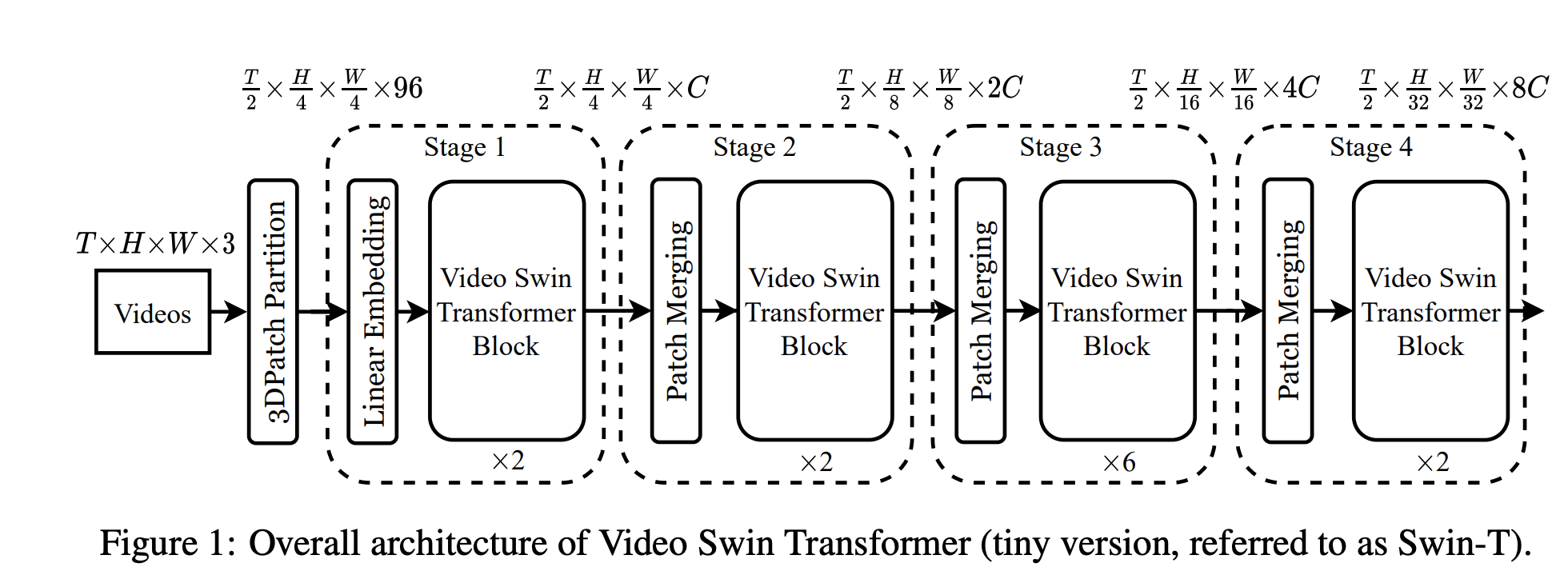
- T : # of frames of video
- 3D Patch Partition
- 3D patch of size 2x4x4x3 as a token ⇒ 3D patch partitioning layer obtains
3D tokens with each patch/token consisting of a 96-dimensional feature
- Then linear embedding layer → project the features of each token to an arbitrary dimension C
- 전반적인 구조는 오리지널 swin transformer를 따라가고 있음
- 4 stages로 구성되어 있음
- 각 스테이지의
Patch merging layer에서 2x spatial downsampling을 진행함.- 패치 개수를 점점 줄이면서 학습함으로써 작은 물체에서 큰 물체까지 모든 정보가 학습될 수 있게 함
-
Video swin transformer block
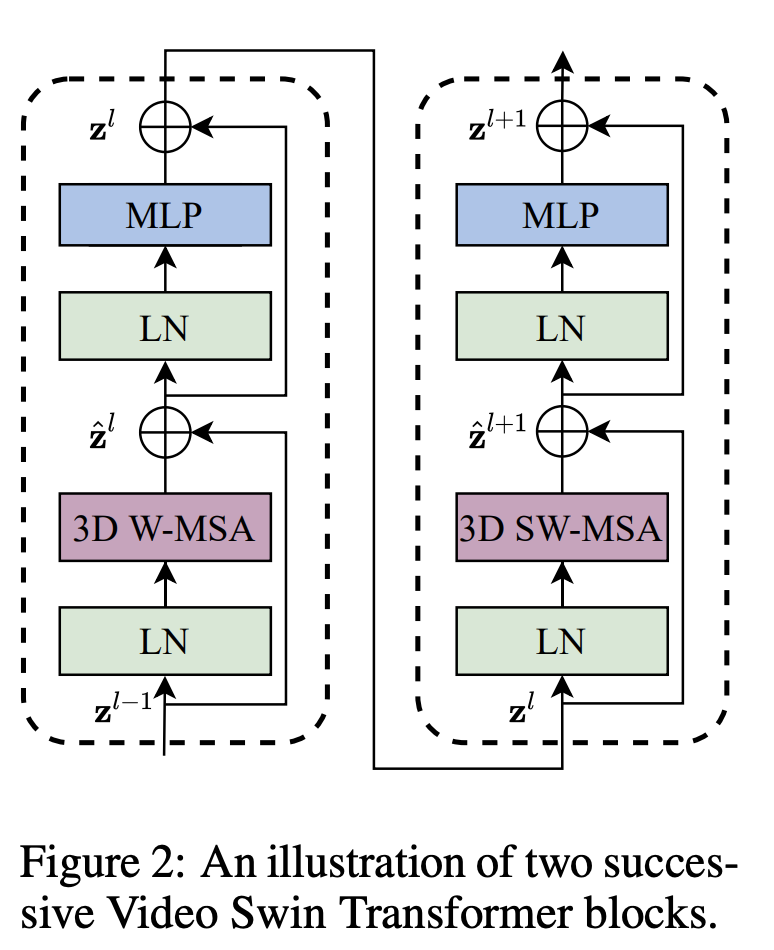
- 3D shifted window based multi-head self-attention module
- Layer normalization
- FF network
- 2-layer MLP with GELU
- 각 모듈이 끝나면 residual connection
3D Shifted Window based MSA Module
- Multi-head self-attention on non-overlapping 3D windows
- Video → T’xH’xW’ 3D tokens 3D window size → PxMxM ⇒ input tokens →
Non-overlapping 3D windows
-
3D shifted windows
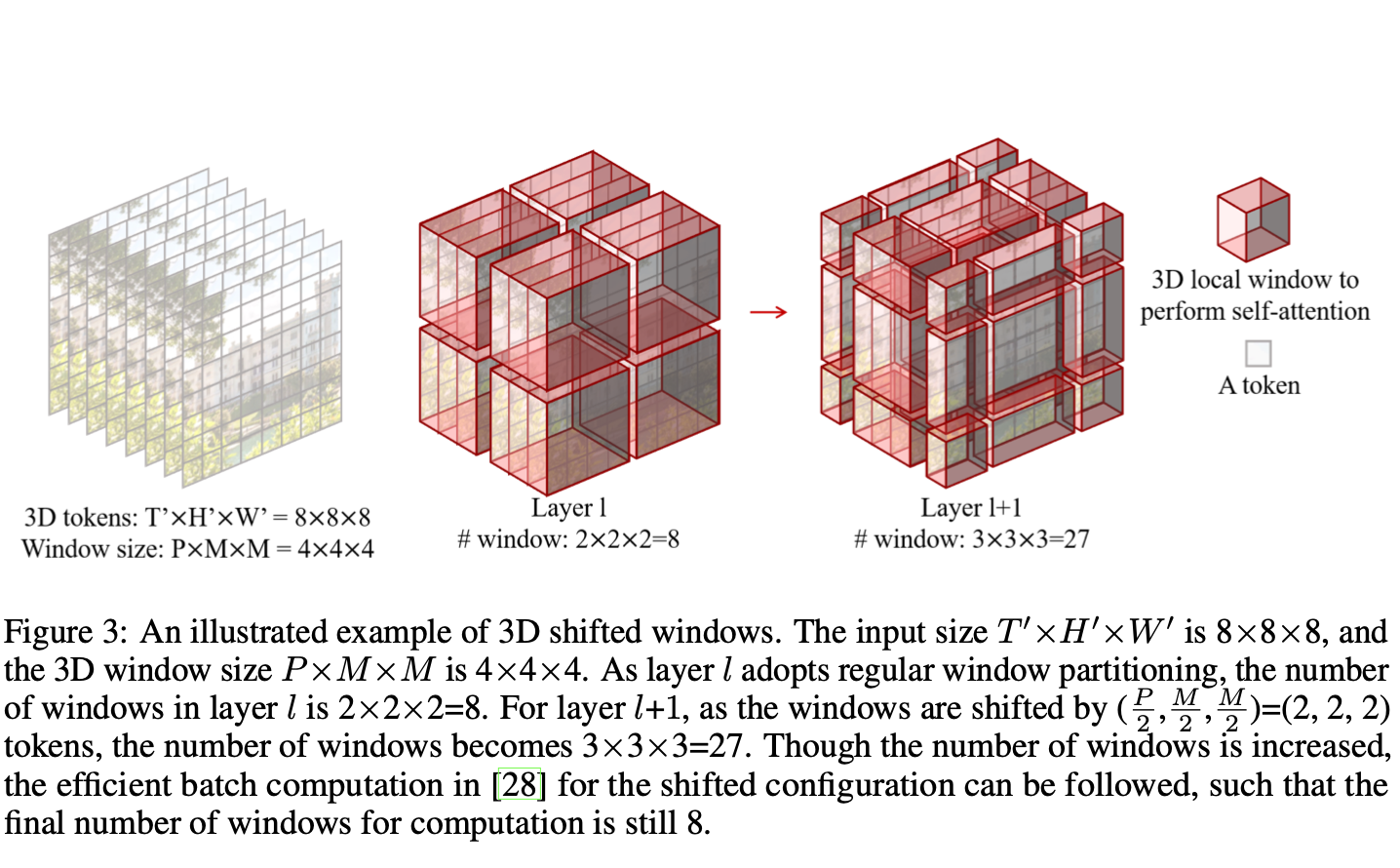
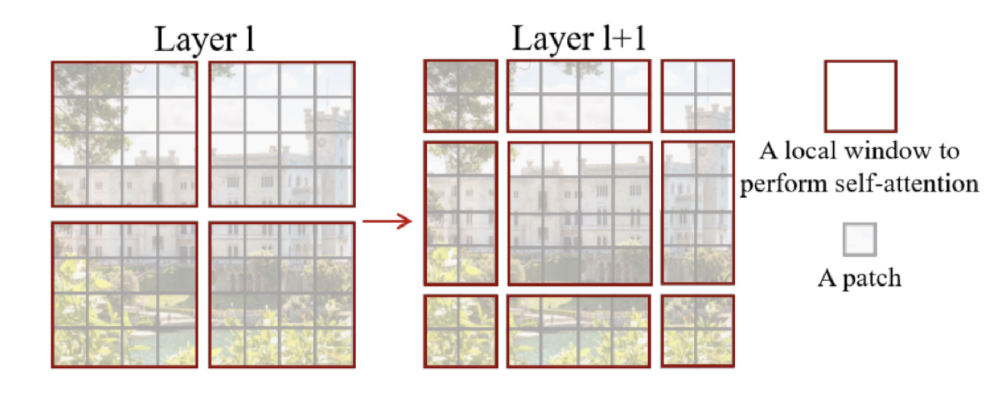
- Non-overlapping 3D window 각각에 MSA를 적용하면 (==
W-MSA) 다른 윈도우 사이의 커넥션 정보가 부족함 → cross-window connections 제안 - Self-attention module에 2개의 레이어 사용
- First layer는 “regular window partition strategy” == 앞서 non-overlapping한 3D windows를 사용
- Second layer는 앞선 레이어에서 shift along the temporal, height, width axes by (P/2, M/2, M/2)한 윈도우를 사용
- (윈도우 크기의 반만큼 이동)
-
Cyclic shift (FROM original Swin Transformer)
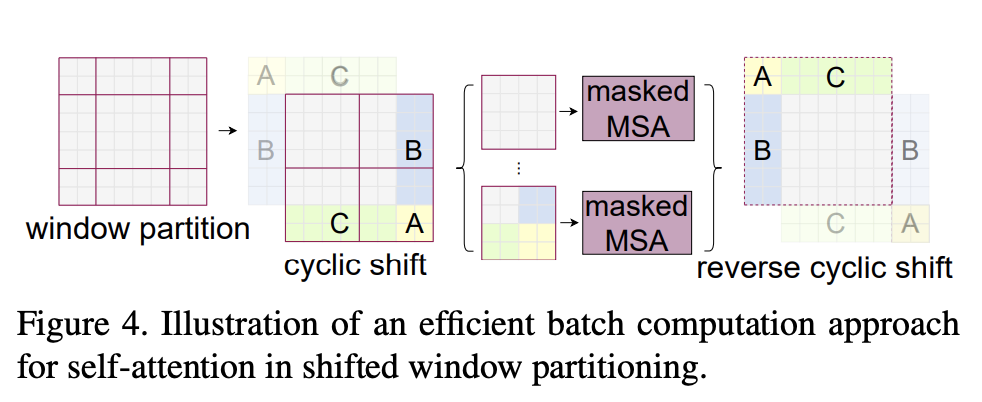
- 몇몇 윈도우는 mxm 사이즈보다 작을 것임(위 그림에서 4x4가 안되는 것들)
- Naive solution : padding ⇒ 윈도우 개수가 늘어남
- 이러한 Sub-window들의 크기를 늘리는 방법이 “cyclic shift”
- 위의 그림처럼 sub-window(A,B,C)들을 우측 하단으로 이동시켜 window크기에 맞게 합친 뒤 self-attention 계산
- 윈도우 개수가 늘어나지 않음
- 새로 붙인 부분들은 인접해있지 않음 → 개별적인 sub-window 내의 attention score를 계산할 수 있도록 masking 기법을 이용한다
- 몇몇 윈도우는 mxm 사이즈보다 작을 것임(위 그림에서 4x4가 안되는 것들)
- Non-overlapping 3D window 각각에 MSA를 적용하면 (==
-
3D Relative Position Bias
\[\begin{equation} B \in \mathbb{R}^{P^2\times M^2\times M^2} \\ Attention(Q,K,V) = SoftMax(QK^T/\sqrt{d}+B)V \\ Q,K,V \in \mathbb{R}^{PM^2\times d} \end{equation}\]
- 다른 모델들과 달리 positional encoding역할이 이 블락 안에 있다
- ViT → q, k, v를 임베딩하기 전에 Positional Encoding
- 상대 좌표를 이용 → 어떤 픽셀을 중심으로 하냐에 따라서 이동해야 하는 값이 달라지기 때문에 sin, cos 주기를 이용한 절대 좌표보다 더 좋다고 한다 // (original) Swin Transformer
각 query의 위치를 기준으로 key의 상대적인 위치를 이용해 임베딩을 더해준다
== 쿼리 기준 키의 상대적인 거리를 얻어서 더해준다
- Relative poision → the range of [-P+1, P-1] (temporal) or [-M+1, M-1] (height or width) ⇒ parameterize a smaller-sized bias matrix
- 다른 모델들과 달리 positional encoding역할이 이 블락 안에 있다
Experiments
- Dataset
- Kinetices-400, 600
- SSv2
- Sample a clip of 32 frames from each full length video using a temporal stride of 2 and spatial size of 224x224 ⇒ resulting in 16x56x56 input 3D tokens (patch size : 2x4x4x3)
- inference (K400, K600)
- 4x3 views
- Uniformly sampled in the temporal dimension as 4 clips
- For each clip, the shorter spatial side is scaled to 224
- Take 3 crops of size 224x224 that cover the longer spatial axis
- For each clip, the shorter spatial side is scaled to 224
- Final score → average score over all the views
- Inference (SSv2)
- Window size in temporal dimension = 16
- 1x3 views
- Final score → average score over all the views
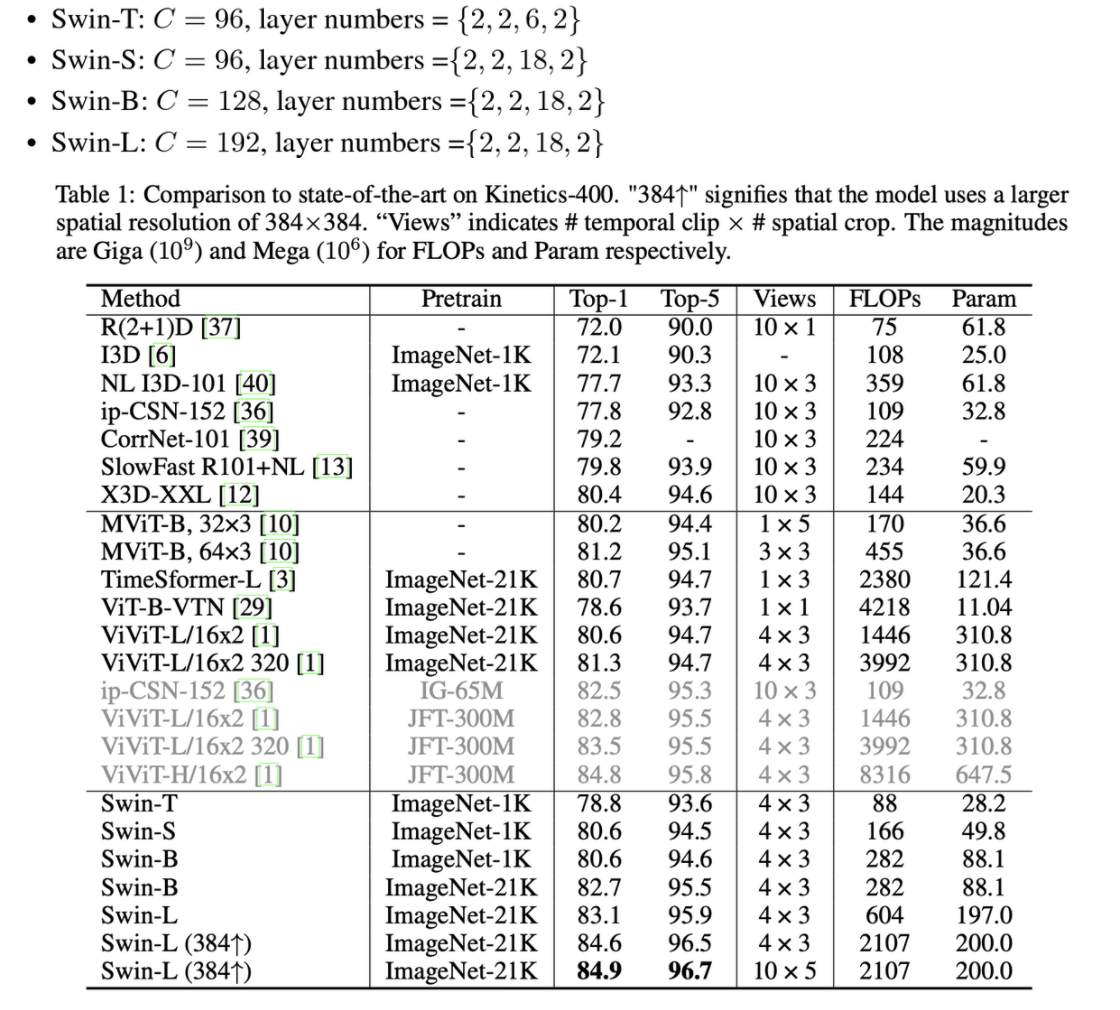
- Ablation Study
-
Temporal dimensions of 3D tokens & Temproal Window Size
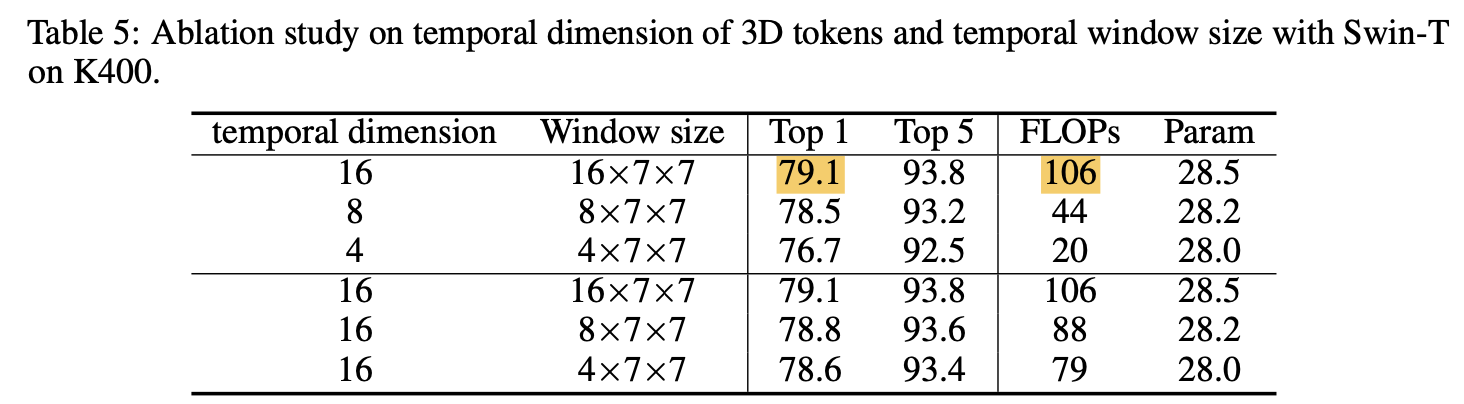
Temporal dimension이 크면 성능은 좋아지지만 computation cost가 커지고 느려짐
-
3D shifted Windows
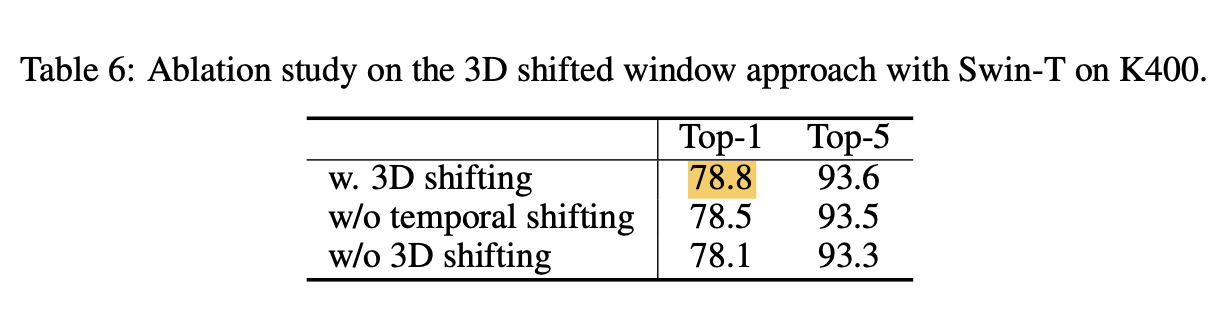
- 3D shifted window vs. Temporally shifted windwos
-
Summary
- Swin Transformer(vision/image transformer) 구조를 Video model에 적용
- Window 기반의 self-attention 계산 (window 내의 patch들끼리만 self-attn을 한다) → Locality 사용, 계산 복잡도 줄임, inductive bias를 활용한다
- Video Swin Transformer block → Window MSA, Shifted Window MSA으로 구성
- 3D Shifted window : 다른 윈도우 사이의 커넥션을 위해 cross window connections 제안
- Sub-window에 Cylic shift를 사용
Reference
Swin Transformer: Hierarchical Vision Transformer using Shifted Windows